
Budgeting vs. cash-flow forecasting: which do you need?
The short answer
A budget plans where your money should go, category by category, over a month. A cash-flow forecast shows when money arrives and leaves, day by day, so you see the tight days before they happen. If you live paycheck to paycheck, timing is usually what bites, and that's what a forecast shows.
A month that balances, and still runs short
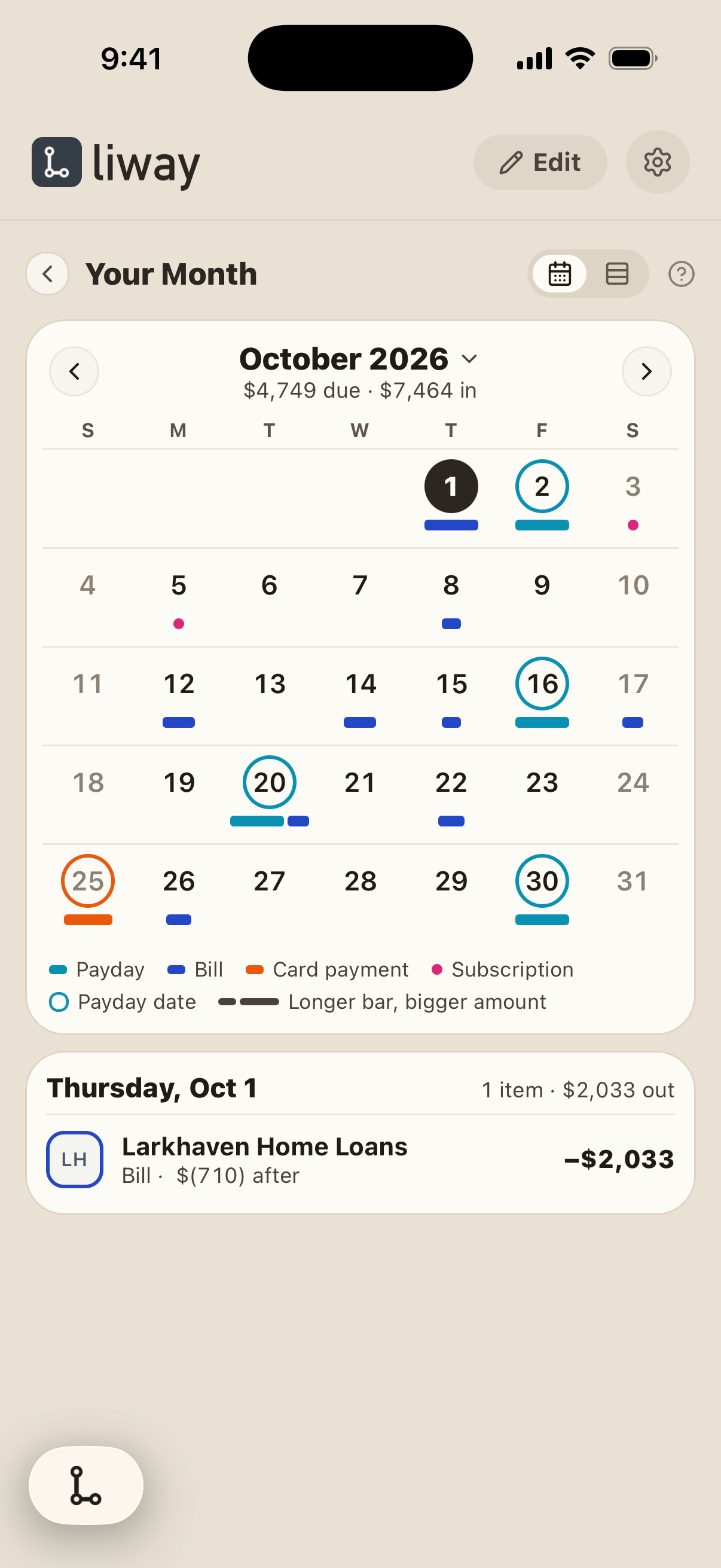
Jordan's October, from liway's calendar. Over the whole month, more comes in than goes out, so a budget says all is well.
But the mortgage, $2,033, is due on October 1, and the paycheck lands on the 2nd. For that one day the shared account is $(710) short. The month balances; the day doesn't. A forecast shows that day weeks ahead. A budget never sees it.
How to work it out yourself
- Use a budget to decide priorities.How much should go to food, fun and savings this month? A budget is a plan for that.
- Use a forecast to see timing.Will there be enough on each day, given when the bills and paychecks land?
- Watch the low point.The lowest balance before the next paycheck is the number that matters most. If it dips below zero, move money or wait.
- Line up big bills with paydays.If a big bill lands just before payday, ask to move its date, or set money aside for it early.
- Use both if you can.They answer different questions. Many people need the forecast first.
Where it gets tricky
- A forecast is only as good as what it knows: a bill it has not seen yet will not be on it.
- Irregular pay makes both harder. Count pay once it lands.
- A budget takes upkeep: categories, limits, reviews. A forecast mostly needs the right bills and paydays.
- Neither replaces a cushion for the unexpected.
How liway does it
liway starts with the forecast: there are no categories to set up before it works. It puts every bill and payday on its day, and shows the short day before it comes, like Jordan's October 1.
Try it with your own numbers.
The Headroom Calculator works it out in a minute, no sign-up. Or let liway do it every day.